


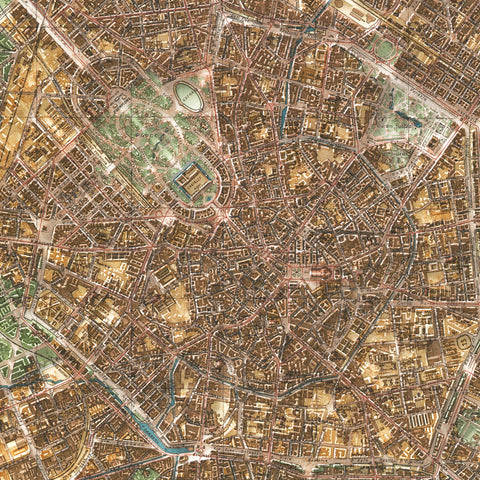
Creating a shaded relief effect on an antique map requires many steps: piece by piece, the final result is built, and every single phase plays a crucial role in the quality of the finished product.
One of the very first steps is the restoration of the selected map. Very often, maps available in libraries and archives have been digitized to prevent their complete loss, but they still present many issues: torn or missing sections, dark stains caused by aging, folds that compromise readability, or deformations that make georeferencing difficult.

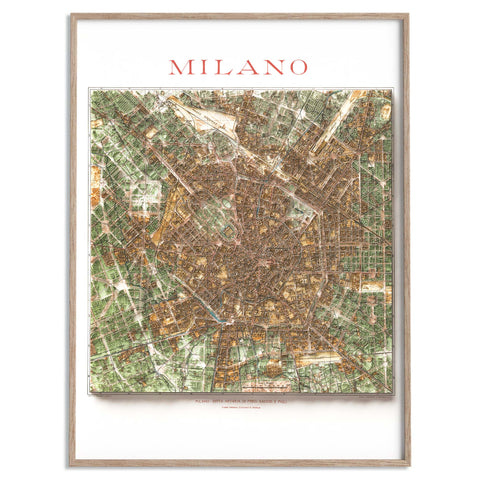
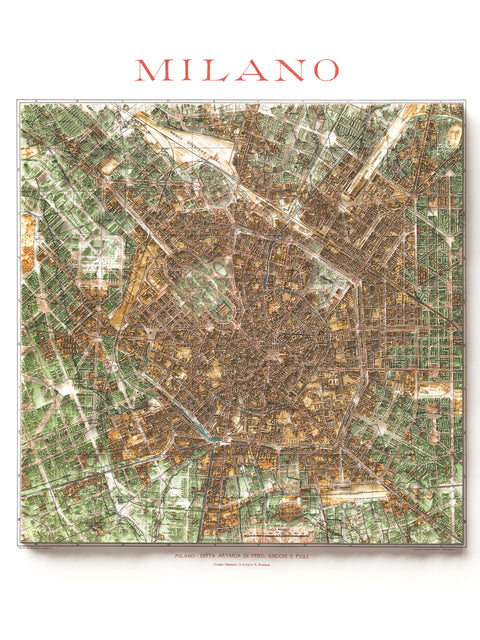
A particularly clear example of these challenges is the map of the city of Milan, created in 1910 by Ferdinando Sacchi and published by Artaria Editore.
This map is a perfect showcase of the difficulties encountered during cartographic restoration: missing areas, heavy staining, folds of various kinds, color alterations, and a strong yellowing of the paper.

The image shown below posed an additional challenge for us. As can be seen in the detail on the left, part of a street name was missing: the only readable fragment was “lice”. How could the full name be reconstructed?

The first step was to analyze the area. The street is a side road off Corso Sempione and, fortunately, it still exists in modern maps. This allowed us to quickly narrow down the possibilities.
Current cartography shows that the street still exists today, but under the name Via Marcantonio dal Re, meaning it was renamed at some point in time. The next step was therefore to compare it with several historical maps of Milan in our archive that had not yet been restored, dating from 1930 to 1945. It seemed reasonable to assume that the original name might have survived at least until those years.
However, this assumption also proved incorrect: as early as 1930, the street was already named Marcantonio dal Re. At that point, there were two options: continue researching or remove the remaining fragment of the old name and leave the street unnamed.
We decided to continue the research by consulting the digitized archives of the Municipality of Milan. Among many documents and cadastral maps, we eventually found one dated 1910—the same year as our map—which clearly showed the street we were looking for. This allowed us to complete the restoration by correctly adding the name “Via Salice”.

Most people who choose to decorate their space with this map will probably never notice this street. They likely wouldn’t even notice if it were left unnamed. Yet this is precisely the essence of restoration: making invisible efforts so that everything appears visible and harmonious.
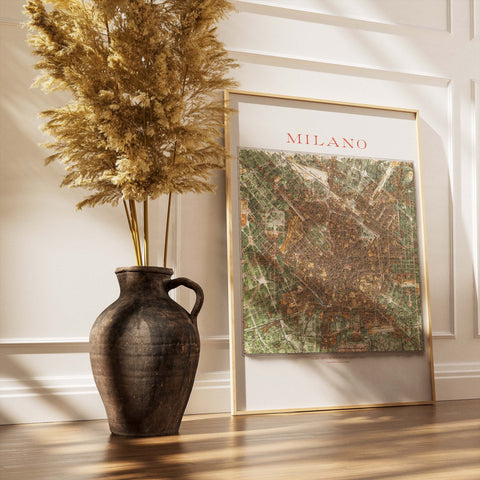
After restoration, the map shed its damaged appearance, regained its original character, and finally evolved into its shaded relief version.

Comments (0)
There are no comments for this article. Be the first one to leave a message!